

When a company needs additional IT personal, there are several options to consider. Two of them are team augmentation and outsourcing.
Both can help companies access professional talent without having to build an entire from scratch. However, their approaches, level of control, responsibilities, and flexibility differ considerably.
For HR and recruitment managers, understanding the differences between the two is important to help companies choose the model that best suits their business and project needs.
Simply put, team augmentation allows a company to add external professionals to its internal team, while outsourcing generally means assigning part of all a specific task or project to a third party.
So, which option is more suitable for your company?
What Is Team Augmentation?
Team augmentation is a working model that allow companies to add external professionals to their internal teams based on their needs.
Under this model, the company retains control over the project, work processes, communication, and priorities. Meanwhile, the team augmentation provider helps supply talent with the required expertise.
For example, a company may be developing a new application and need:
- 2 software engineers
- 1 UI/UX designer
- 1 QA engineer
However, the company may not want to hire permanent employees because these resources are only needed for the duration of the project.
With team augmentation, the company can add professionals with the required skills to its existing team without having to build a new team from scratch.
This makes team augmentation, suitable for companies that need flexibility in managing their IT team’s capacity and expertise.
What Is Outsourcing?
Outsourcing is a working model in which a company assigns certain tasks or functions to an external company to be managed and completed based on an agreed arrangement.
In IT outsourcing, for example, a company can outsource the development of software, websites, applications, or systems to a software house or technology vendor.
Under this model, the vendor is generally responsible for carrying out the work based on the agreed scope, timeline, and deliverables.
This means the company does not have to directly manage every team member working on the project. The vendor manages the resources and work processes to produce the agreed deliverables.
Outsourcing can be an option for companies that want to focus on their core business while assigning specific technology-related work to a party with specialized expertise.
Team Augmentation vs. Outsourcing: What’s the Difference?
Although both involve external professional, team augmentation and outsourcing have different characteristics.
Here is a simple comparison:
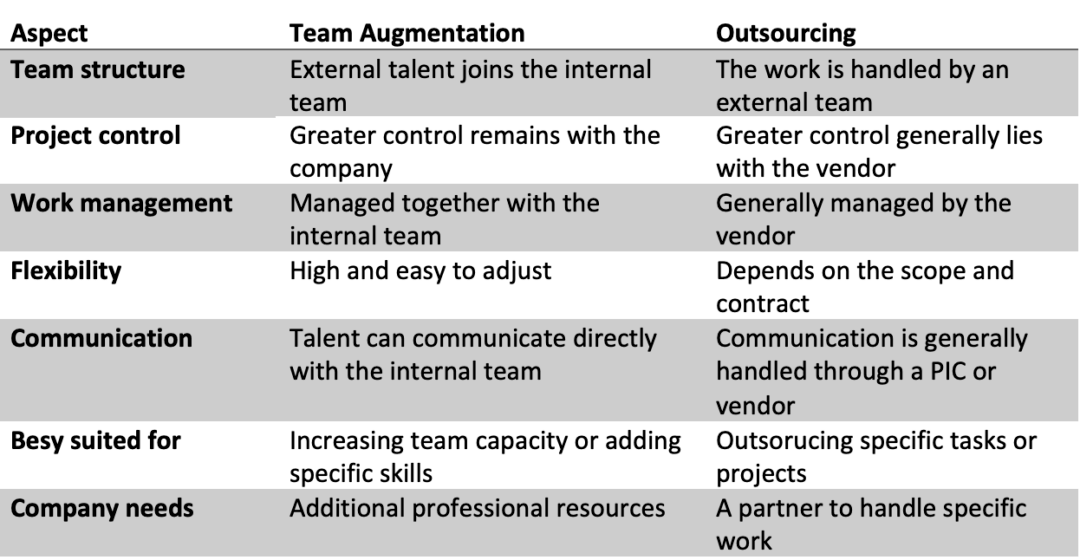
Given these differences, choosing between team augmentation and outsourcing should not be based solely on cost. Companies should also consider the desired level of control, project duration, skill requirements, internal capacity, and work complexity.
When Should a Company Choose Team Augmentation?
Team augmentation can be an option when a company wants to maintain direct control over a project while needing additional professionals.
Some situations that may be suitable for this model include:
1. The Internal Team Needs Additional Capacity
For example, a development team may be working on several projects at the same time while its workload continues to increase.
Instead of hiring permanent employees for needs that may only last for a few months, a company can use team augmentation to increase its team capacity as needed.
2. The Company Needs Specific Skills
Not every company has all the technology skills it needs within a single team.
A company may already have developers but need professionals with experience in specific areas such as:
- AI development
- Cloud computing
- Mobile development
- Backend development
- Frontend development
- QA automation
- UI/UX design
Team augmentation allows companies to access these skills without having to start the recruitment process from scratch.
3. The Project Deadline is Approaching
Projects that are approaching their deadlines often require additional resources to stay on track.
The recruitment process can take time, from candidate sourcing and screening to interviews and onboarding.
With team augmentation, companies can add resources based on project requirements more flexibly.
4. The Company Still Wants to Manage the Team Directly
If managers want to continues determining tasks, priorities, workflows, and day-to-day communication, team augmentation can be a more suitable option than full outsourcing.
When Is Outsourcing the Right Choice?
Outsourcing can be an option when a company wants to assign specific work to an external party without having to manage the entire development process internally.
This model is suitable when:
- the company does not have a sufficient internal IT team:
- the company wants to develop software without building its own team
- the project has a clearly defined scope and deliverables
- the company wants to focus on its core business
- the company needs a technology partner to handle the entire project.
For example, a company may want to build an internal application but does not have a software team.
Instead of hiring developers, designers, QA engineers, project managers, and other positions, the company can work with a software house to handle the application’s development process.
Team Augmentation vs. Outsourcing: Which One Is Better?
There is no single model that is always better for every company.
The right choice depends on the company’s business needs and level of involvement in the project.
If a company wants to:
- maintain control over the team
- quickly increase team capacity
- gain access to specific technology skills
- continue managing tasks and wokflows
- adjust the number of resources based on project needs
then team augmentation may be the more suitable option.
On the other hand, if a company wants to:
- assign a project to an external party
- reduce the need to manage an IT team
- receive outputs based on a specific scope
- focus on its core business
then outsourcing may be a more suitable alternative.
What Are the Benefit of Team Augmentation for HR and Recruitment?
For HR and recruitment managers, fulfilling IT staffing needs can be a challenge of its own.
Certain technology positions may require candidates with highly specific skills. At the same time, these needs may not necessarily be permanent.
Team augmentation provides an alternative when a company needs additional professionals without immediately increasing its permanent headcount.
Some of the benefits include:
1. Resource Flexibility
Companies can adjust the number and type of talent based on project requirements.
2. Reduce Recruitment Time
Companies do not always have to start the hiring process from the scratch when they need additional personnel for a specific project.
3. Access to Talent with Specific Skills
Team augmentation can help companies access professionals with technology expertise that matches their project requirements.
4. Support for the Internal Team
Rather than replacing the internal team, additional talent can work alongside the existing team to increase capacity and complete tasks.
5. Easier Adjustment to Project Needs
When project requirements change, the composition of resources can also be adjusted without having to build a permanent team structure for every new requirement.
How Do You Choose the Right Model?
Before choosing between team augmentation and outsourcing, HR and management can consider the following question:
1. Who will manage the day t0 day work?
If the company wants to directly manage the professionals involved, team augmentation can be an option.
2. Does the company already have an internal IT team?
If the company already has a team but needs additional capacity or skills, team augmentation can help complement that team.
3. Is the IT staffing need permanent?
If the need only lasts for a specific project, using external resources can provide greater flexibility.
4. Does the company want to outsource the entire project?
If so, outsourcing can be a more practical option.
5. How much control does the company want to retain?
The more control a company wants to maintain over its team and work processes, the more relevant team augmentation becomes.
Team Augmentation for Software Development Needs
For companies undergoing digital transformation or developing digital products, technology staffing needs can change quickly.
One project may require several developers. The next project may require a combination of developers, QA engineers, UI/UX designers, or AI specialists.
Building all of these skills into a permanent team is not always the most efficient option.
This is where team augmentation for software development can provide flexibility.
Companies can add the professionals they need to their teams based on project requirements, while the internal team continues to maintain control over the development process and goals.
This model can also be an option for companies looking to accelerate product development without having to go through the hiring process for every new requirement.
Why Do Local and Global Businesses Choose Vodjo for Team Augmentation?
Choosing a team augmentation partner is not simply about getting additional personnel. Companies also need to ensure that the talent provided has the right competencies and can collaborate effectively with the internal team.
Vodjo is a software house that provides technology and software development services, including team augmentation, to help companies access additional professionals for various software development requirements.
Vodjo’s team augmentation service can be an option for companies looking to:
- increase software development team capacity
- access talent with specific technology skills
- accelerate project development
- complement their internal IT team
- gain resource more flexibly
- work with professionals who can collaborate with their internal team
This approach allows companies to remain focused on their project goals and management, while Vodjo helps provide the technology resources they need.
Team Augmentation or Outsourcing? Choose Based on Your Company’s Needs
Team augmentation and outsourcing can both help companies meet their technology needs, but they take different approaches.
Team augmentation is more suitable when a company needs additional talent while still wanting to maintain direct control over its and project.
Meanwhile, outsourcing is more suitable when a company wants to assign specific work or a project to an external partner to manage and complete based on an agreed scope.
For HR and recruitment managers, understanding these differences can help them determine a solution that better matches their company’s resource requirements.
If your company is looking for a way to increase IT team capacity, gain access to specific technology skills, or accelerate software development without adding permanent headcount, team augmentation may be a solution worth considering.
Vodjo is ready to help companies build or complement their technology teams with resources that match their project requirements.
Contact the Vodjo team for a free consultation now.